
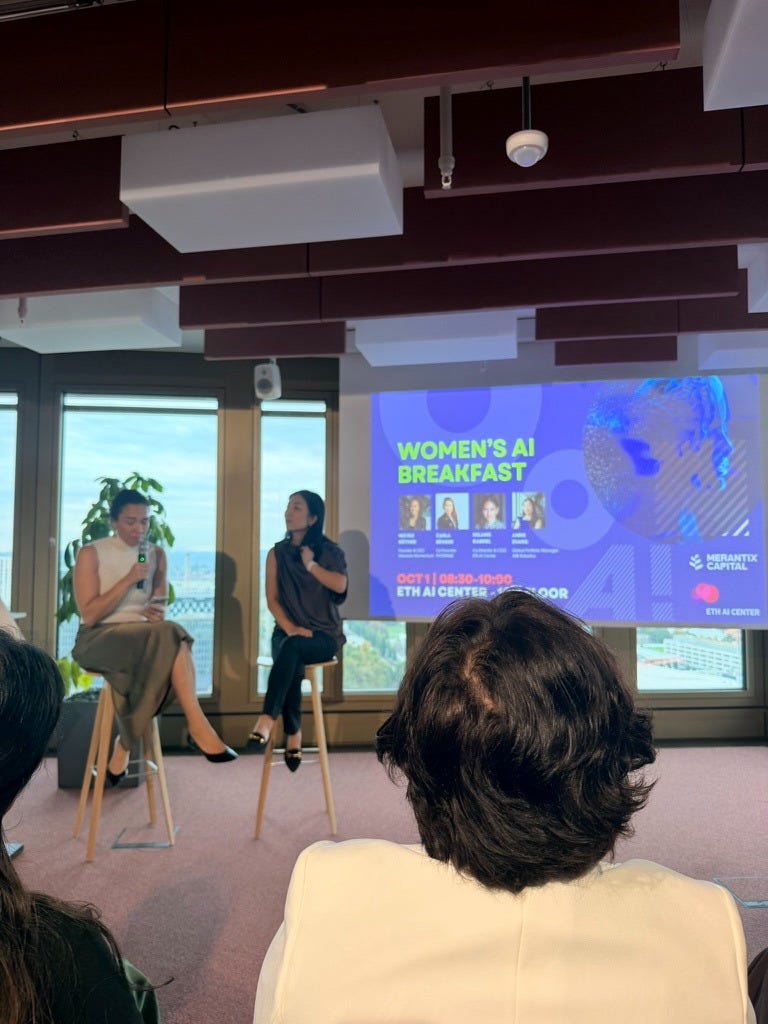
Across Zurich AI Festival, I moved through three rooms that looked unrelated. A breakfast at the ETH AI Center was about how AI founders land their first enterprise customers. A DeepL executive dinner asked what Swissness means when language technology scales. A Swissnex event looked ahead to the Geneva AI Summit 2027 and asked how a small, open economy should approach safety, sovereignty and the power of frontier models.
Together they pointed to one conclusion. Switzerland does not need to beat Silicon Valley at the frontier-model capital game. It needs to become the place where powerful models are made precise enough, governable enough and commercially useful enough to enter the institutions that matter.
Three rooms, one operating question
The official theme of the 2026 Zurich AI Festival was Trusted Intelligence. The festival brought research, policy, founders and industry into the same city, but the most useful discussions were not about whether AI is impressive. They were about the operating conditions required for adoption.
In the first room, the question was commercial: how do you convert a strong demo into a customer relationship that survives procurement, security review and the first production failure? In the second, it was linguistic: how do you scale globally without flattening the terminology, cultural signals and privacy requirements that make a system trustworthy locally? In the third, it was political: who accepts responsibility when capability advances faster than institutions can absorb it?
These are not separate questions. They are the same bottleneck viewed from three sides. Model capability is becoming abundant. Institutional permission remains scarce.

The first client is a product problem
The Women in AI Breakfast, hosted by ETH AI Center and Merantix Capital, was refreshingly specific about the transition from product-market theory to revenue. The first enterprise client is difficult because the startup is not selling a finished object. It is negotiating the boundary of the product in real time.
That is why a design partnership needs more than a discounted pilot. It needs a named business owner, a painful problem, a defined user, a decision date, a paid scope and reciprocal value. If the customer receives early access and influence, the startup should receive data, implementation access, reference rights or a credible path to a larger contract. Six months of unpaid customization for one logo is not traction. It is outsourced product development with asymmetric risk.
The point becomes even sharper in physical AI. A robotics team can build excellent perception, planning and control, yet still fail in production because lighting changes, a gripper meets variable stiffness, maintenance is too specialized, or the operator interface assumes a university education. The engineer, line supervisor, systems integrator, procurement lead and person signing the check are different users. Each experiences a different product.
The best sequence is therefore industrial use case first, technical architecture second. Start with a narrow workflow in logistics, inspection or manipulation. Map the end-to-end journey, including exception handling and maintenance. Define the next best alternative, which may be a human process or an older machine rather than another AI product. Then prove that autonomy improves the total operating equation: throughput, safety, quality, downtime and cost.
When AI is finally adopted, we often stop calling it AI. It becomes translation, inspection, scheduling, navigation or quality control. That is a useful test. The goal is not to preserve the label. The goal is to make the capability disappear into a workflow that people trust.
Swissness at scale means precision under constraints
DeepL’s Swissness at Scale executive dinner made the language layer tangible. In regulated enterprises, a translation or writing system is not valuable because it can produce fluent text. It is valuable when it preserves meaning across legal terms, product names, local conventions, tone and access controls.

Language carries values. A model that performs well in global English can still fail in Swiss German, Romansh, a specialized legal clause or a technical maintenance instruction. The error may look small at token level and be material at business level. This is why evaluation must move beyond aggregate benchmark scores toward terminology accuracy, semantic preservation, refusal behavior, traceability and performance by language, domain and risk class.
Swissness should not mean pretending every component must be invented or hosted inside the country. Good technology matters, and Swiss companies need access to frontier models. The more defensible position is model optionality: use the best proprietary model where capability is decisive, an open model where inspection and adaptation matter, a smaller edge model where latency and privacy dominate, and a domain model where specialized performance creates value.
That is the difference between sovereignty and isolation. Sovereignty is the ability to choose, inspect, switch and continue operating. It is not a ban on outside capability.
Trust is an operating model
One of the sharpest observations from the week was that the limiting factor in enterprise adoption is often an internal fight over ownership. Who owns the data? Who approves the model? Who carries the budget? Who accepts the incident? Who is willing to put their name on the deployment?
A policy document cannot answer those questions by itself. Trust requires a control system: a use-case owner, documented model and data lineage, pre-deployment testing, human escalation, fallback procedures, monitoring for drift, incident reporting and a clear threshold for stopping the system. Without this structure, a responsible-AI committee becomes a place where decisions wait.
The emergence of AI insurance is a useful signal. Munich Re already offers cover for model underperformance, including risks linked to prediction error, calibration and data drift. Insurance does not make a model safe. It forces a more mature question: can the risk be measured, priced, monitored and contractually allocated?
That change matters because leaders are not choosing between innovation and risk. They are choosing which risks they understand well enough to take. The organizations that scale AI will be those that convert an ambiguous technology concern into a governed operating exposure.
Geneva can offer a third position
The Geneva Loading program, created by Swissnex in San Francisco with Mercator Foundation Switzerland, is preparing Swiss participants to bring a grounded Silicon Valley perspective to the Geneva AI Summit in June 2027. The official summit theme, Bridging Innovation and Trust, is well chosen. The hard part is turning it into a position with substance.

The debate is frequently flattened into two caricatures. One side treats market competition as the best risk-management system. The other reaches first for top-down rules. Neither is sufficient. Markets can reward speed before harms are visible. Regulation can freeze categories while the technology changes underneath them.
Switzerland can occupy a more useful middle ground because it combines research capacity, industrial engineering, financial and insurance expertise, multilingualism, international law and a reputation for institutional stability. Neutrality helps convene opposing camps, but neutrality is not the same as safety. The Swiss contribution has to be technical: evaluation access, interoperable standards, incident protocols, auditability, model portability and evidence about how systems behave in real settings.
The stakes go beyond existential-risk arguments. They include deepfakes that weaken democratic trust, models that change how people learn and reason, automated decisions that are difficult to contest, military applications, and neurotechnology that can restore speech or extend perception. We should resist the temptation to stop teaching writing, judgment and critical thinking simply because software can perform parts of those tasks.
A sentence from the room stayed with me: “I do not know what I think until I read what I write.” Writing is not only an output. It is a cognitive process. An AI system can accelerate it, but organizations and schools still need to protect the human capability that gives the output context.
Build a model portfolio, not a national chatbot
Switzerland already has a credible foundation in Apertus. Developed by ETH Zurich, EPFL and CSCS and trained on the Alps supercomputer, Apertus 1.5 is fully open and adds multimodal understanding, stronger reasoning and tool use. Its purpose is not to beat the largest private frontier systems. It is to provide transparent infrastructure that institutions can inspect, adapt and deploy with confidence.
The strategic opportunity is therefore broader than a token shop or a single sovereign model. Switzerland can build the assurance and deployment layer around a portfolio of models. That includes multilingual evaluation, confidential inference, sector-specific adaptation, edge deployment, industrial integration, insurance, certification and governance tooling.
It also requires a more coherent national front. Research institutions, cantons, federal agencies, industrial companies, insurers, cloud providers and startups cannot each build a separate adoption stack. A one-Switzerland approach does not mean centralized control. It means shared test infrastructure, procurement pathways, interoperable standards and a clear route from laboratory capability to enterprise reference customer.
The executive scorecard has changed
The old AI scorecard rewarded parameter count, benchmark rank, pilot volume, research prestige and the size of the model budget. Those metrics measured technical possibility. They did not measure institutional adoption.
The new scorecard should track time to first paid value, pilot-to-production conversion, active use inside the target workflow, accuracy by language and domain, cost per completed business outcome, model-switching time, data and model lineage coverage, human-escalation rate, incident frequency, recovery time, referenceability and renewal. For physical AI, add uptime, intervention rate, safety events, maintenance hours and performance under changing environmental conditions.
This shift is necessary because capability is moving faster than organizational absorption. The moat is migrating from access to a model toward the ability to integrate it, govern it and earn permission to keep it in production.
Switzerland does not need the world’s biggest model. It needs to become the place where institutions decide which models are precise enough, transparent enough and accountable enough to matter. The prize is not a Swiss chatbot. It is the trust layer of the AI economy.