
California is where the AI story still feels weightless. Models, agents and robots arrive as software demonstrations, product launches and investment theses. But standing with a group of industry peers in Silicon Valley, the conversation kept returning to something much heavier: substations, transformers, cooling loops, fiber routes, construction schedules and power contracts.
That is the paradox of the current AI cycle. The user experience is increasingly invisible, but the infrastructure behind it is becoming industrial. Physical AI makes this especially obvious. A robot may act at the edge, but its foundation models, synthetic data, fleet learning and simulation pipelines still depend on dense centralized compute. What looks like intelligence on a screen or motion in a machine is backed by a chain of chips, networks, buildings, utilities and capital.

The data-center stack is the product
For years, data-center conversations were compressed into three numbers: rack count, installed megawatts and power usage effectiveness, or PUE. Those numbers still matter, but they no longer describe the operating system of an AI factory.
The modern stack begins with accelerators and high-bandwidth memory, then expands into servers, rack-scale fabrics, storage and the software that schedules and serves models. Underneath sits an electrical system of grid interconnections, substations, transformers, switchgear, uninterruptible power, batteries and backup generation. Beside it sits a thermal system of cold plates, pumps, chillers, heat exchangers and water or air rejection. Around all of it are land, fiber, permits, contractors, utility tariffs and community consent.
The layers are coupled. A higher-density rack can improve compute per square metre while raising the difficulty of heat rejection. Liquid cooling can improve chip performance and reduce fan energy, yet shift the design burden into pumps, water chemistry and facility integration. A renewable power purchase agreement can support new generation, but it is not the same as having carbon-free electricity available every hour at the site. A GPU delivery date is commercially irrelevant if the substation is three years late.
For physical AI, the stack also stretches outward. Training and simulation remain concentrated in large facilities, while inference increasingly moves into vehicles, robots and factories. The competitive system is therefore not cloud versus edge. It is a coordinated loop between centralized training, digital twins, deployed machines and the data they return.
California designs the stack. America builds where power clears.
California remains unusually good at assembling the intellectual and commercial layers of AI: semiconductor architecture, cloud platforms, model companies, robotics, venture capital and customers who will fund an aggressive roadmap. The state does not need to host every new campus to control much of the system’s design and economics.
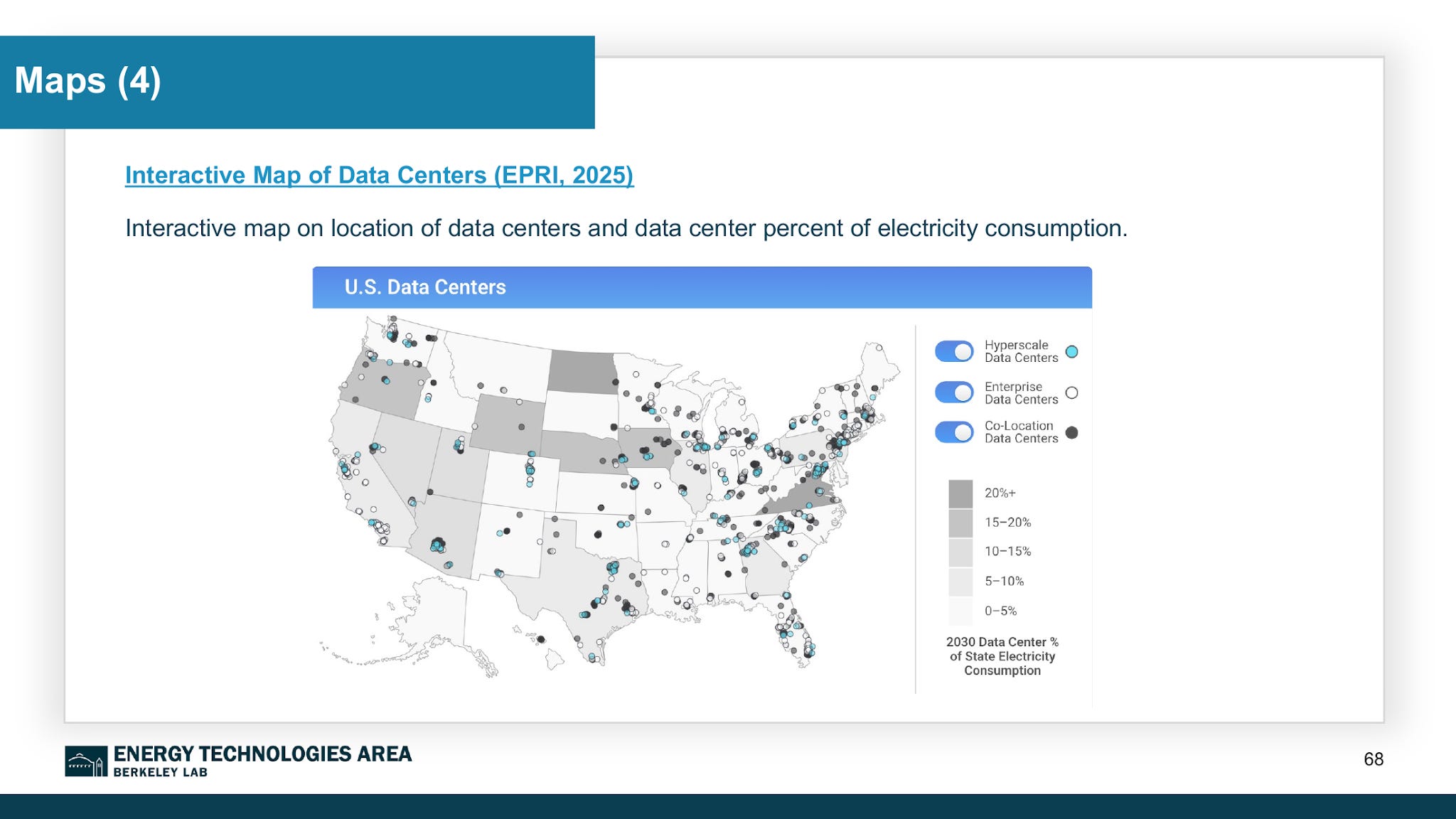
The physical build-out follows a different map. A 2025 Department of Energy review placed the largest US data-center utility demand in Virginia at 12,118 MW and Texas at 9,683 MW, followed by Oregon, Arizona, Georgia and Ohio. California still ranked among the leading markets at 2,667 MW, but the geography of the next wave is moving toward locations that can combine land, fiber, tax treatment and a credible path to power. New activity is also spreading into Indiana, Louisiana, Minnesota, Mississippi and Missouri.
That changes the meaning of location. Northern Virginia remains powerful because of its network density and installed ecosystem. Texas offers land, scale and a market accustomed to large energy deals. Oregon couples cloud campuses with hydro-rich power. Arizona and Nevada offer land and fiber, but expose projects to heat and water constraints. Georgia and Ohio are becoming large-load markets because utilities and local governments are prepared to negotiate around grid expansion and economic development.
The map below is more useful than a list of campuses because it shows two realities at once: facilities cluster, and their impact on state electricity systems is highly uneven.
Demand is real, but the curve is not frictionless
The latest IEA outlook estimates that global data-center electricity consumption rose 17 percent in 2025 and will roughly double from 485 TWh in 2025 to 950 TWh in 2030, around 3 percent of global electricity demand. Consumption in AI-focused facilities is expected to triple over the same period. In the United States, the IEA expects data centers to account for around half of total electricity-demand growth through 2030.
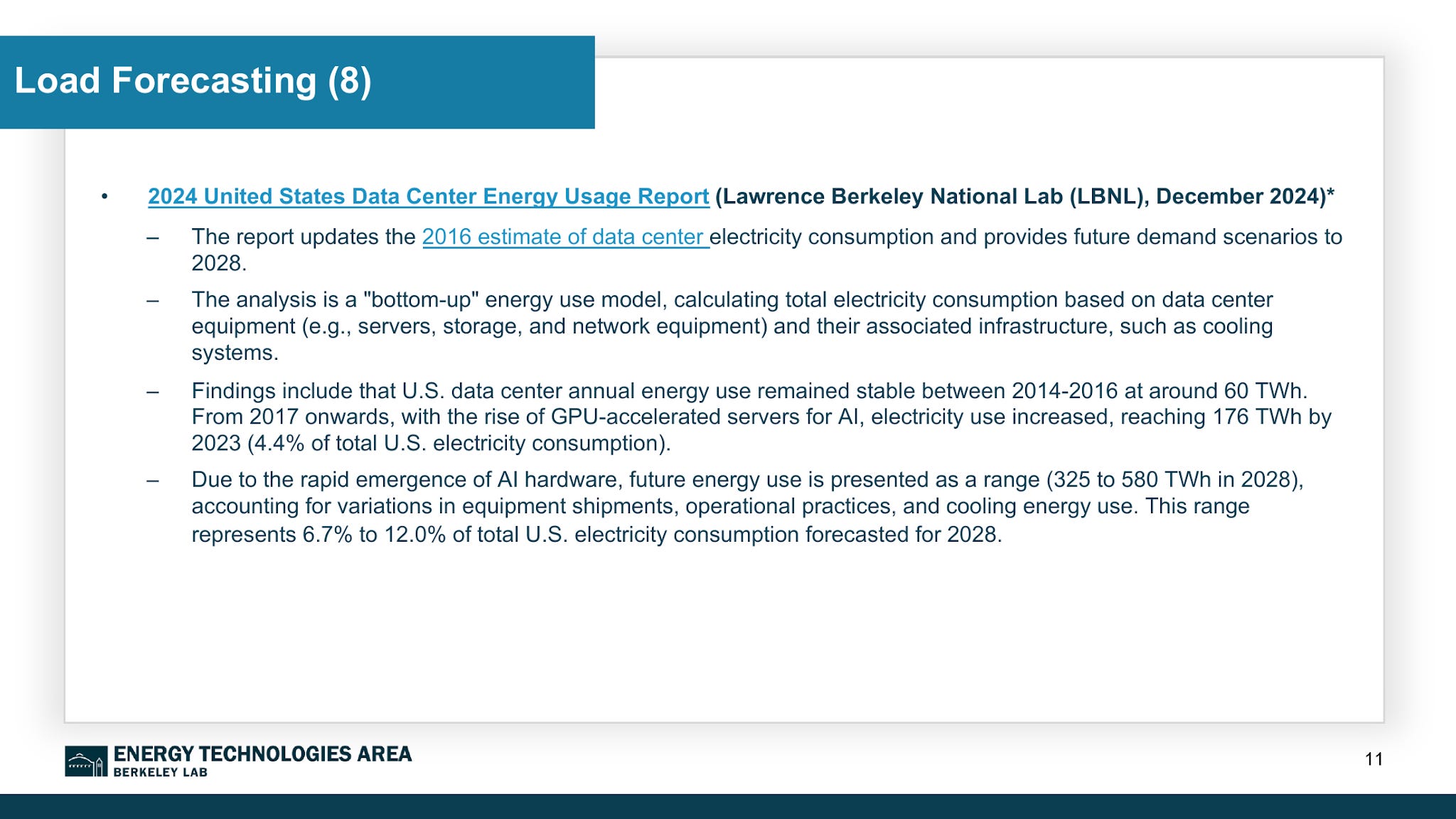
Berkeley Lab’s 2025 update is even more useful for US planning. Its reference case reaches 649 TWh in 2030, or 11.8 percent of US electricity use, with a sensitivity range of 9.5 to 15.3 percent. That spread is not analytical weakness. It captures the variables that matter: accelerator shipments, chip lifetimes, utilization, idle power, cooling performance and the pace at which projects can actually energize.
This is why the market should not be described as either an unstoppable supercycle or a bubble. End demand, model capability and capital spending are accelerating. At the same time, power equipment, grid connections, permits and construction capacity are rationing the near-term curve. Announced capacity is not operating capacity. A project pipeline can expand while commissioned megawatts remain scarce.
Capital is becoming infrastructure finance
The funding model is changing as fast as the hardware. The IEA reports that capital expenditure by five large technology companies exceeded USD 400 billion in 2025 and is expected to rise another 75 percent in 2026. That amount cannot remain a simple line item on technology-company balance sheets.
The market is moving toward project finance, special-purpose vehicles, private credit, infrastructure funds, real-estate capital and long-term capacity leases. Goldman Sachs notes that 695 infrastructure funds were raising an aggregate USD 555 billion as of May 2026, while hyperscaler capital-expenditure estimates were rising faster than completed construction.
This financial engineering is not a side story. It determines which projects survive. Lenders increasingly care about contracted power, tenant credit, equipment obsolescence, lease duration, construction guarantees and refinancing exposure. A campus backed by a bankable tenant and an executable interconnection schedule can attract capital. A speculative site with an impressive rendering and no firm power date cannot.
The next correction, if it comes, is therefore unlikely to hit every asset equally. Scarce powered land, reliable interconnections and modular designs should retain strategic value. Projects built on optimistic utilization, expensive short-term debt or hardware that ages faster than the financing schedule will be repriced first.
California and Europe are optimizing different systems
California’s advantage is not simply risk appetite. It is the density of a private coordination system. Capital, cloud demand, chips, software, talent and prospective customers can be assembled quickly around one thesis. Companies are willing to pre-commit to capacity, sign long contracts and redesign products around the infrastructure they expect to exist.
Europe is building from a different starting point. The European Commission is mobilizing EUR 20 billion for AI gigafactories, with 77 proposals across 60 sites in 16 Member States and first construction targeted for 2027. Europe also brings genuine strengths: industrial automation, scientific computing, cleaner power systems in several markets, district-heating experience and a serious culture of energy efficiency and sovereignty.
Its constraint is coordination. Power markets, permits, financing pools and procurement remain fragmented, while industrial electricity prices are structurally higher than in the United States. Europe can still win important layers of the stack, but it should not copy California’s hyperscaler model mechanically. Its better route is sovereign and industrial compute placed close to reliable power, manufacturing clusters and end users, with heat reuse, long-term power contracts and cross-border capacity designed in from the start.
Water rights are compute risk
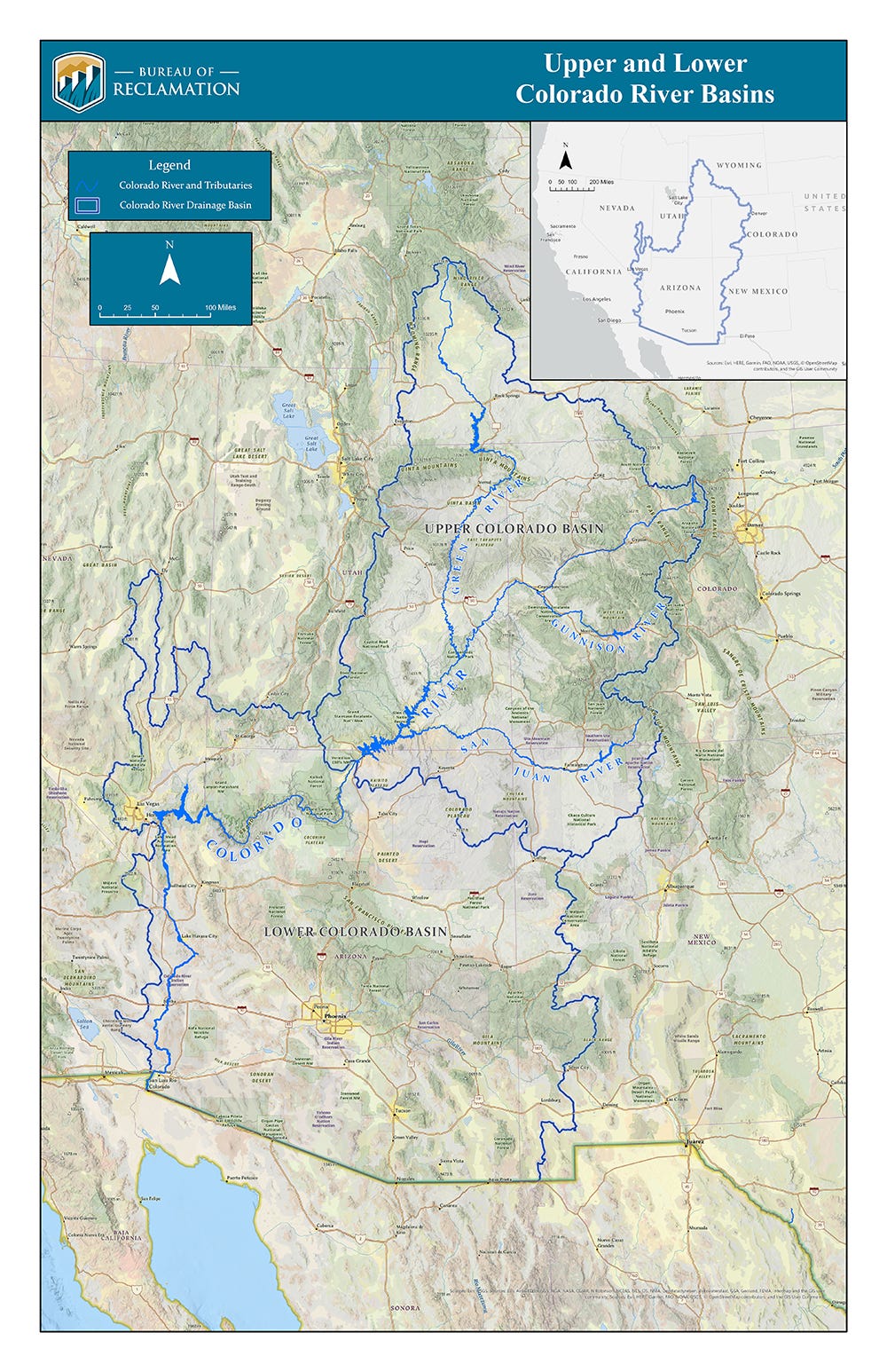
The Colorado River is not a metaphor for scarcity. It supports seven US states and Mexico, and between 35 and 40 million people rely on it for at least part of their municipal water. In April 2026, the Bureau of Reclamation said long-term drought had reduced system storage to about 36 percent of capacity.
It would be misleading to say that every western data center buys Colorado River rights directly. Most facilities are served by a municipality or utility. But that does not remove the exposure. It moves it into the provider’s supply portfolio, priority rights, drought rules, groundwater limits, reuse capacity and future rate base. A site can have a water-service letter today and still face higher costs, operating restrictions or political opposition later.
Water usage effectiveness, or WUE, is therefore necessary but incomplete. Executives should ask for consumptive use by watershed, source mix, drought tier, peak-day demand, reclaimed-water availability and the energy penalty of the chosen cooling design. Air cooling can reduce on-site water consumption while increasing electricity use. Evaporative cooling can lower power demand while increasing local water consumption. The correct optimization is at system level, not through a single sustainability ratio.
Community permission is now on the critical path
Local opposition is often described as anti-technology. That misses the substance of the dispute. Communities are asking who pays for substations and transmission, who absorbs noise and diesel emissions, how water use is disclosed, how many permanent jobs remain after construction, and whether tax incentives compensate for the public infrastructure required.
Fairfax County, Virginia, now reports 20 standalone data centers in operation and 11 under construction. Its policy work has addressed siting, noise, design, energy and water, while Virginia has moved toward industry water-use reporting. In Arizona, residents have challenged large campuses over noise, pollution, water and nearby gas generation. Nevada’s 2026 responsible-development standard explicitly requires developers to cover project-related costs rather than shift them to ratepayers and to protect water supplies, the grid and local communities.
These are not soft issues. They change schedules and cash flows. Community trust, transparent water reporting, enforceable noise limits and fair large-load tariffs now belong in project execution alongside transformers and fiber. Social license has become an infrastructure input.
My market prognosis
First, power will remain the primary rationing mechanism through 2030. The best projects will be measured by energized megawatts on a credible date, not announced gigawatts. Utilities will demand deposits, minimum bills, collateral and stronger cost-allocation rules before building for speculative loads.
Second, the map will continue to diversify. Northern Virginia, Texas and the established cloud markets will remain large, but growth will move toward energy-rich regions, retired industrial sites, campuses with existing grid access and locations able to add generation. The winning site is increasingly an electrical project with a data-center building attached.
Third, flexible compute will become financially valuable. Training, batch inference and some simulation workloads can be shifted in time or location. A facility that can curtail briefly, migrate workloads or coordinate on-site storage may connect faster and obtain better tariffs than a load that demands full output every hour of the year.
Fourth, financing will separate strategic assets from financial replicas. Private capital will keep expanding, but underwriting will become more demanding as debt maturities, construction delays and equipment cycles collide. Tenant concentration and residual hardware value will matter as much as headline demand.
Finally, Europe will scale, but selectively. Its strongest opportunity is not to recreate the US map. It is to build an integrated sovereign and industrial compute layer around power, manufacturing, research and regulation, then use efficiency and system design as competitive advantages.
The executive scorecard has changed
The old scorecard rewarded announced megawatts, rack count, construction budget and PUE. The current scorecard should track energized megawatts by date, interconnection certainty, useful compute per constrained MW, time to first power, revenue per kWh, network utilization, capex per MW, tenant credit, water exposure by watershed, community-permitting cycle and refinancing risk.
That shift matters because the AI race is no longer constrained only by who can design the smartest model. It is constrained by who can assemble land, electrons, water, fiber, equipment, capital and public permission into a system that operates on schedule.
The next data-center winner will not be the largest project announced. It will be the fastest bankable megawatt converted into reliable intelligence.
If you are planning AI capacity, do not start with the GPU count. Start with the constrained resource, then design the compute, financing and operating model around it.